


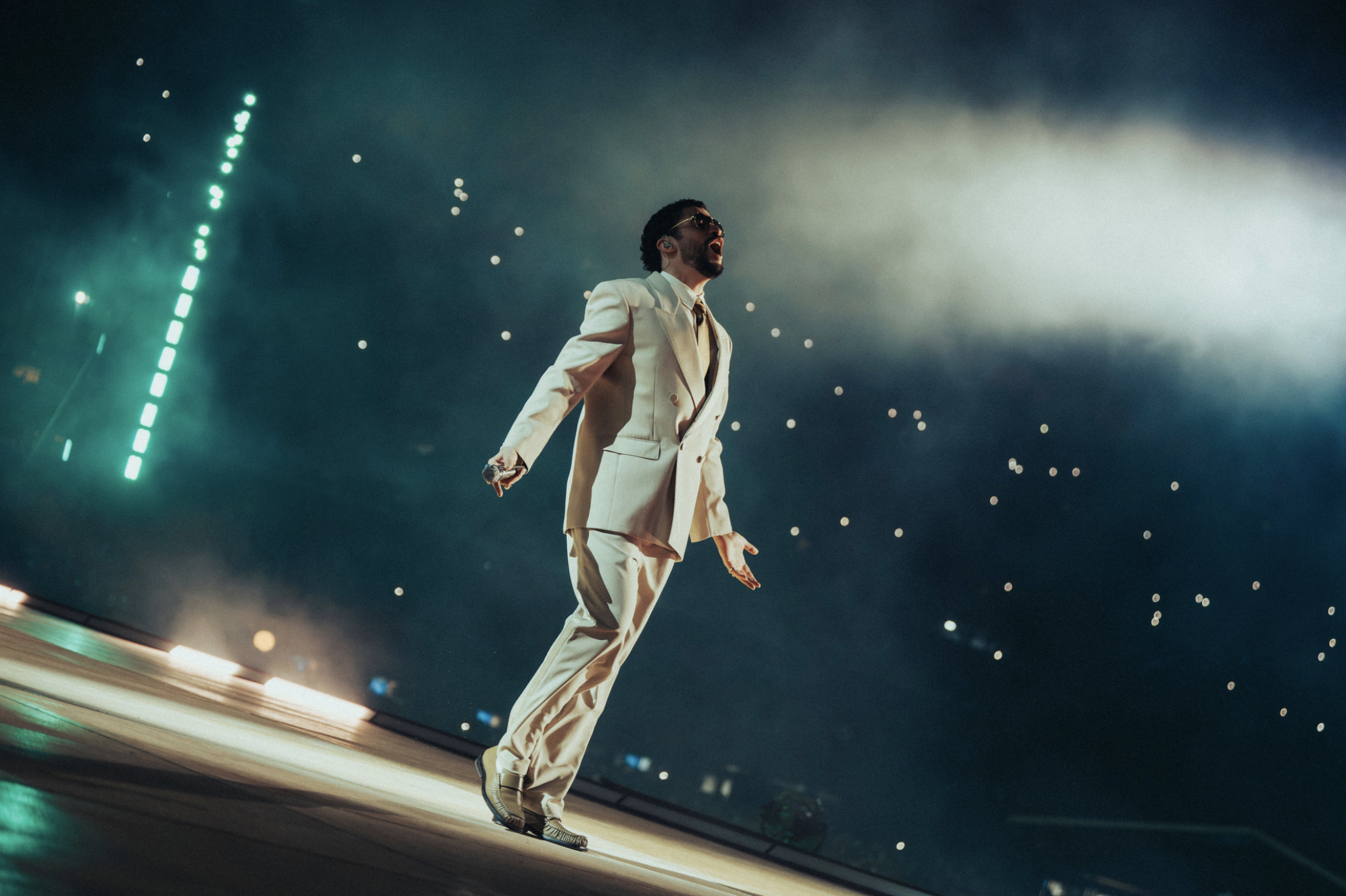
Photo Credit: Edwin Rodriguez
Benito Antonio Martínez Ocasio, known as Bad Bunny, has had a meteoric rise to the top of the global music scene since his 2016 commercial hit “Diles.” He is an artist rooted in Latin Caribbean culture, taking bold risks and organically growing his fan base slowly but surely. Those gambles have caused him to continue to cash in big time.
This includes refusing a United States residency because of the social and political turmoil surrounding ICE and immigration protocols. Instead, he pivoted and brought his influence back to his homeland, carving out a 30-show residency at the José Miguel Agrelot Coliseum in San Juan. The residency is currently sold out.
The 31-year-old rapper and singer continues to produce hit album after hit album, with each release bigger than the last. While operating on such a global stage, he is experiencing a multigenerational moment—breaking and shattering records. Most recently, he reclaimed Spotify’s most-streamed-artist title from Taylor Swift in 2025.
Who would’ve thought a grocery store clerk and college student from the rural town of Almirante Sur in Vega Baja, Puerto Rico, would now have one of the grandest opportunities any music creator could dream of—headlining the 2026 Apple Music Super Bowl halftime show.
Bad Bunny’s catalog and cultural reach
Bad Bunny’s catalog is packed with era-defining records such as “Soy Peor,” “I Like It,” “Callaíta,” “Tití Me Preguntó,” “Me Porto Bonito,” and “Yonaguni.” These songs have dominated charts while reshaping the sound of modern Latin music.
His albums—including X 100PRE, YHLQMDLG, El Último Tour del Mundo, Un Verano Sin Ti, and Nadie Sabe Lo Que Va a Pasar Mañana—have each served as cultural moments. They blend reggaeton, trap, pop, and introspective storytelling, while consistently debuting at or near the top of the Billboard charts.
Beyond music, Bad Bunny has become a global fashion and cultural icon. He has appeared in major modeling campaigns for Adidas, Calvin Klein, and Gucci. He also serves as a brand ambassador who challenges traditional gender norms and beauty standards on a worldwide stage.
His presence across music, fashion, and global branding has cemented him not just as an artist, but as a generational figure whose influence extends far beyond the stage.
Top five most memorable Super Bowl halftime shows
To celebrate such a monumental moment on Sunday, February 8, I’ll be taking you on a trip down memory lane. This is a countdown of the top five most memorable Super Bowl halftime shows.
This list highlights artists who made a distinct and lasting impact on musical culture. While it is impossible to include every iconic performer, I narrowed the list down to five. These selections focus on what I believe were the most impactful, culturally significant, and conversation-shifting halftime performances in history.
5. Kendrick Lamar — Super Bowl LVI (2022)
Kendrick Lamar appeared during Super Bowl LVI in 2022 as part of a West Coast–centered halftime show. The Los Angeles Rams defeated the Cincinnati Bengals at SoFi Stadium that night.
Leading up to the performance, Kendrick had already established himself as hip-hop’s most critically respected voice. Albums like good kid, m.A.A.d city, To Pimp a Butterfly, and DAMN. redefined rap as both street reportage and high art.
His music consistently addressed themes of systemic oppression, racial identity, survivor’s guilt, and social responsibility. His halftime appearance carried that weight, even within an ensemble performance.
The stage design resembled a layered urban landscape, evoking Compton backdrops and West Coast iconography. Kendrick’s measured movements and stripped-down presentation contrasted sharply with the spectacle-heavy tendencies of modern halftime shows.
In a music landscape increasingly driven by viral hits and surface-level consumption, Kendrick’s presence reinforced hip-hop’s role as political commentary and cultural documentation on one of the world’s largest platforms.
4. Beyoncé — Super Bowl XLVII (2013)
Beyoncé headlined Super Bowl XLVII in 2013 as the Baltimore Ravens defeated the San Francisco 49ers in New Orleans. The performance was equal parts athleticism, precision, and authority.
Entering the Super Bowl, Beyoncé was already firmly positioned as pop’s most dominant figure. She was fresh off 4 and on the verge of releasing her surprise self-titled album, which would later reshape the music industry’s relationship with digital releases.
Her halftime stage featured bold lighting and a commanding silhouette-driven setup. Razor-sharp choreography emphasized control and endurance throughout the performance.
Themes of empowerment, legacy, and excellence ran through the set. The show culminated in a Destiny’s Child reunion that bridged generations of R&B and pop fans.
At a time when pop music leaned heavily into electronic production and spectacle, Beyoncé reaffirmed the importance of live performance discipline, vocal strength, and the commanding presence of Black women at the center of global pop culture. For related coverage, revisit OTR II Tour Comes To Buffalo.
3. Prince — Super Bowl XLI (2007)
Prince delivered a transcendent performance at Super Bowl XLI in 2007 as the Indianapolis Colts defeated the Chicago Bears in Miami.
An unexpected rainstorm transformed the stage into something cinematic. Prince and his band were silhouetted against massive purple backdrops, turning the weather itself into an artistic collaborator.
By this point, Prince was already a towering musical figure. The halftime show reintroduced his genius to a generation experiencing the early digital transition of music consumption.
The performance leaned heavily on live instrumentation, guitar virtuosity, and emotional intensity. “Purple Rain” became a near-spiritual moment as rain poured down.
In an era dominated by polished pop performances, Prince reminded audiences of raw musicianship, genre-blending freedom, and the power of improvisation. A deeper look at the performance can be found via Rolling Stone.
2. Janet Jackson — Super Bowl XXXVIII (2004)
Janet Jackson performed at Super Bowl XXXVIII in 2004 as the New England Patriots defeated the Carolina Panthers in Houston.
Leading into the game, Janet was riding decades of influence. Albums like Control, Rhythm Nation 1814, and All for You had reshaped pop, dance, and R&B.
The halftime show featured futuristic staging and high-energy choreography. It reflected the maximalist pop spectacle of the early 2000s.
However, the wardrobe malfunction involving Justin Timberlake overshadowed the performance. The moment triggered a massive cultural backlash that reshaped broadcast standards and censorship policies.
The fallout disproportionately impacted Janet’s career. It exposed enduring double standards around race, gender, and accountability in pop culture. More context is available at Rolling Stone.
1. Michael Jackson — Super Bowl XXVII (1993)
Michael Jackson delivered the most iconic halftime show of all time at Super Bowl XXVII in 1993. The Dallas Cowboys defeated the Buffalo Bills in Pasadena.
At the time, Michael Jackson was already the most recognizable entertainer on the planet. Thriller and Dangerous had redefined global pop stardom, music videos, fashion, and choreography.
His halftime performance introduced a revolutionary concept—treating the halftime show as a global concert event.
The stage emphasized scale and spectacle. Massive crowd participation, carefully timed pauses, and television-first choreography transformed expectations forever.
Themes of unity, humanitarianism, and global connection underscored the performance, particularly during “Heal the World.” The blueprint for every halftime show that followed was set that night. A retrospective can be found at Rolling Stone.
Why this year feels different
For the music community, even if you do not care about sports or football, the halftime show has always been revered as a global spectacle.
For fifteen minutes, everyone stops what they’re doing. They tune in to see their favorite performers do something spectacular and memorable.
For many people, a moment like this is worth far more than any trophy or any single game victory.